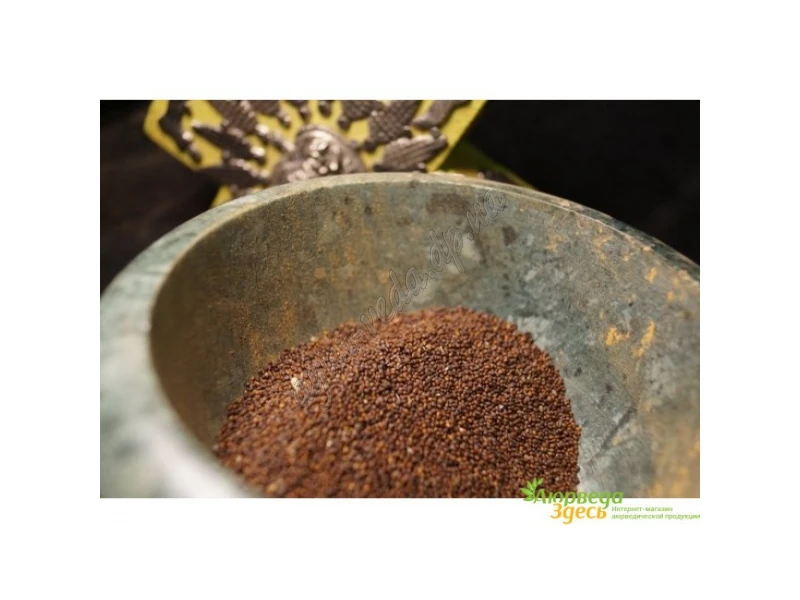
Packaging: 10g.
Tulasy "Holy Basil" is a perennial herbaceous shrub. It is grown through seedlings. Seedlings that have reached a height of 5-7 cm are transplanted to a permanent place: in open ground, a balcony box or a window container. After the appearance of 4-6 leaves, the top is pinched so that the plant grows and grows.
Medicinal effect:
1. It exhibits strong antiseptic and antibacterial properties due to the content of eugenol and a complex of other substances in the essential oil. It is used to prevent and treat headaches, heart diseases, various forms of inflammation, poisoning, and malaria. The cleansing and disinfecting effect of tulasa is also manifested on a subtle level - it is believed that this plant cleanses a person's aura, drives away evil spirits, destroys negative elements, and cleanses the mind and heart.
2. It has a diaphoretic and antipyretic effect.
3. Effectively removes mucus from the lungs and nasal passages
4. It is a good expectorant used for coughs and bronchitis (especially in combination with honey, ginger and onions). The dried plant in a decoction (1 per 10) is a home remedy for cough, bronchitis, colds and diarrhea.
5. It has an antispasmodic effect.
6. Improves absorption of nutrients.
7. It has antitumor and radioprotective properties.
8. Strengthens nervous tissue, cures nervous weakness, reduces stress, acts as an antidepressant at the level of the central nervous system.
9. Improves memory, taken in combination with honey, restores connection with Brahma-marma.
10. It is an antioxidant and immunomodulator
11. The juice of the leaves is used externally for fungal infections of the skin, for various irritations, ulcers, and exhibits pronounced healing properties.
13. Mixed with a small amount of ginger, the juice of the leaves is given to eliminate colic in children. Fresh juice is given as an antiemetic and anthelmintic.
14. A decoction of leaves with a small addition of cardamom powder is a means of increasing sexual energy.
It is grown at home year-round under the condition of good lighting and regular watering. The leaves are used in cooking and medicinal purposes. Tulasi is also popular as a decorative indoor plant.
As you know, the plant can be planted in several ways. In this case, they practice planting with seeds and seedlings. The second method is the simplest, correct, especially if you are engaged in growing basil in open ground. But if you need speed, practicality, spend a minimum of effort on this process, then seeds are exactly what you need. But you are mistaken if you think that it will be enough to simply put them in the ground and water them.
Tulasy-deva.
Actually, basil is a tropical herb that needs special care. If it is simply sown, germination will be no more than 30%. Humidity, temperature, planting depth, pre-soaking, germination - all these are not only desirable stages before sowing. These are mandatory measures, which we will now consider in more detail in the step-by-step instructions.
Heating grains. The homeland of these spices is central India, where the temperature during the vegetation period of the plant is not lower than +28 degrees. The cells are activated only when the seeds are exposed to the sun, when they are heated to +35-40 degrees. If the temperature is lower than specified, they can lie in the ground for 1, 2 or even 3 weeks, which will not satisfy the requirements of many gardeners. What should be done? Just put it in the sun, let the grains warm up to +40 degrees. If it's cold outside, you can do it with the help of a boiler or any object that can maintain +40C.
Soaking. This is the most important step that cannot be missed. After you have warmed up the seed material a little, it must be properly soaked with moisture. Soak for at least 20 hours, and the water should be relatively warm, preferably +40 degrees. There is no need for this step if basil is planted for the winter - there the seeds need a little rest, it is not necessary to stimulate the intensive growth of the vegetative mass. The length of the day will not correspond to the needs of the plant, even if the temperature is high. (Well, this does not apply to the heat-loving Krishna tulasa))
Sowing in the soil. If you want to grow fruitful, healthy basil, planting should be carried out at a temperature of at least 20 degrees. That is, it should enter the open ground in the third decade of May, not earlier. Seeds can germinate and germinate even at +10 degrees during the day, but do not forget that even +5 at night can destroy your entire crop - this culture is very capricious, it does not tolerate cold.
Now let's figure out how to plant basil and what is needed for this. Loosening the soil, adding sand to it is the key to obtaining good seedlings. Do not forget to mulch the ground with humus so that it does not crack - 2 centimeters of mulch will be enough to cover moisture and create optimal conditions for seedlings. The soil should be pre-fertilized with manure 3-4 months in advance, so that it has time to decompose, separate all the trace elements and acids necessary for the plant.
Sowing can be done in several ways. The most popular is to scatter grains over the entire area and work the area with a rake. Of course, there is a risk that many seeds will be on top and disappear over time, but if you can afford such expenses, then it is better to do it this way. Efforts will be minimal. Many gardeners practice digging small furrows - grooves 3-4 centimeters long with rows 30 centimeters apart. Such laughter is very effective, saves your time, has little loss of material, compared to the first method.
There is also a checkerboard method of seeding. Each grain is deepened (it can be done with a finger, a match or a garden tool to loosen the soil) by 1.5-2 centimeters at a distance of 15 centimeters in diameter from each "neighbor". The advantage of the method is a solid economy of space, greater productivity due to the equal spacing of plants. There is, perhaps, only one drawback - a lot of work and time will be spent on this process.
After you have done everything and leveled the ground from above (preferably compacted it with something), you can wait for seedlings, which can actually be obtained within 12 days, if the air temperature does not fall below +15С. To speed up this process and help the seedlings make their way to the top, you can cover the entire bed with polyethylene or any other material to create a greenhouse effect. Plants will feel great in such an "incubator", the main thing is not to forget to remove the film.
Propagation with the help of seedlings
It is very difficult to achieve friendly seedlings and a large harvest from a small seed, but a healthy plant grown on the windowsill gives much better chances. That is why seedlings are so popular when growing crops in open ground. Let's say you already have it purchased or obtained as a result of growing your own seeds. What to do next - we will consider in more detail.
We loosen the ground on the bed. The fraction should be like when sowing corn. It is advisable to use rollers so that the soil is compacted and the roots easily absorb water from the soil and the basil develops fully.
We dig pits of 10x10x20 centimeters, where the last indicator is the depth. We pour 5 grams of saltpeter on the bottom, a little soil on top, place the plant and pour water so that everything dissolves well, and the root system immediately receives a large amount of fertilizer.
Mulch the earth from above with humus so that it does not crack. This is desirable for beds that are just in the shade and mandatory for areas under the open sun. It is best to avoid direct rays - there may be plant burns and growth retardation, spices grow best under 30% shade.
Following seedling care is very simple. 1 foliar feeding with urea or diluted saltpeter every 2 weeks. Pinching is necessary after the fifth pair of leaves has formed on the plant. You can mow the seedlings after 3 weeks - at the discretion of the gardener.
Tulsa Seeds, Holy Basil, Tulasi, brown, 10g., Tulasi Seeds, Tulasi devi, Ocimum sanctum Tulsi, Holy Basil seeds, Ayurveda Here
Ayurveda Here! - an online store of Ayurveda, cosmetics, spices, Indian clothing and jewelry. The best selection of Ayurvedic products in Ukraine! Beauty and health for you and your family! http://aur.in.ua/ #ayurvedasomewhere http://ayur-veda.dp.ua/