Description
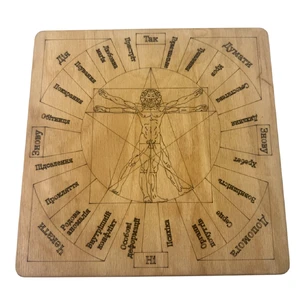
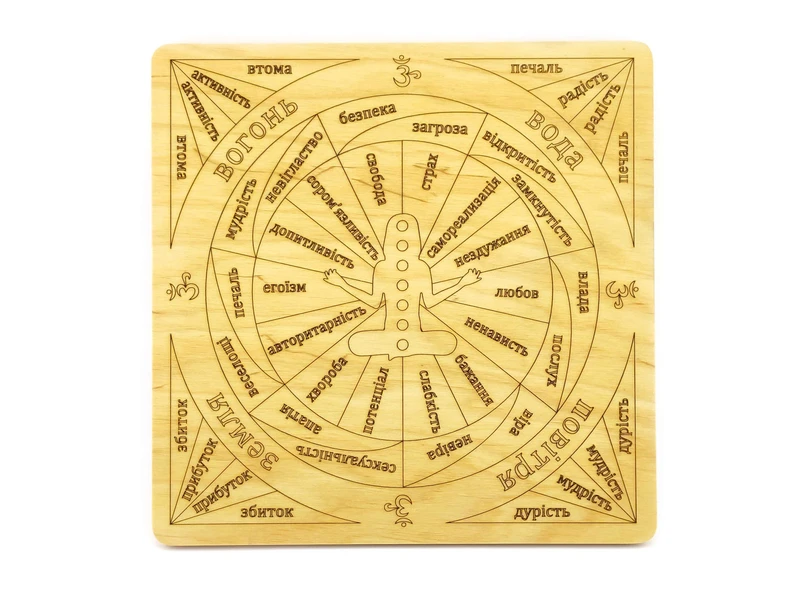
Chakra table in Ukrainian (26x26x0.8cm). covered with linseed oil with beeswax
Chakra table is a unique diagnostic tool that allows you to get information about the causes of what is happening to a person in a short period of time.
The table has several sectors that provide relevant information:
– Internal sector – the figure of a person with chakras. It is used to detect chakras in which there are anomalies.
– Rays from the figure – an indication of the condition or the main motive of the situation, which provokes the anomaly:
– Fear – a person is afraid of something, and it distorts his behavior.
– Self-realization – a person seeks self-realization, but does not know how to do it.
– Misunderstanding – a person feels that he is not understood, and this causes the condition being studied.
- Love is a feeling that is the basis of the process.
- Hate is an emotion that a person feels towards someone, and this emotion distorts his behavior.
- Desire is a bright desire that changes a person's behavior.
- Weakness - a person believes that he cannot cope with the situation - considers himself weak.
- Potential - a person has potential, feels it, but at the same time does not know how to use it implement.
– Illness – a person is sick (he does not always know that he is sick), but the feeling of illness changes his behavior.
– Domineering – a person is too domineering and overwhelms the situation.
– Egoism – a person in action and action is focused only on his own interests.
– Curiosity – a person is simply curious, he wants to know something.
– Shyness – a person feels timid and shy.
– Freedom - a person feels free and therefore behaves in this way.
Separated elements in a circle
Separated elements in a circle will allow you to understand how a person is set up in the context of his feelings, which you saw in the rays. Each ray, or more precisely, two rays, associated with a certain reaction of a person - they tell how a person himself is aware of his condition.
Freedom/Fear - Security/Threat
Self-realization/Ununderstanding - Openness/Closedness
Love/Hate - Power/Submission
Desire/Weakness - Faith/Disbelief
Potential/Disease – Sexuality/Apathy
Domineering/Selfishness – Cheerfulness/Sadness
Curiosity/Shyness – Wisdom/Ignorance
For example, you found out that a person is afraid of something - the pendulum swings over the center of FEAR. You shift the pendulum higher, trying to clarify what he is afraid of - SAFETY.
This means that his Fear is spontaneous and not conditioned by a real situation. Just be afraid and that's all. Next, by moving the pendulum to the elements, you will get an exact answer. Each of the elements has its own behavioral and plot background.
Water – emotions, feelings, experiences, excitement, love.
Air – plans, thoughts, ideas, reflections, aspirations.
Earth – material, money, benefit, work.
Fire – activity, aggression, aspirations, desires.
You move the pendulum from element to element and get an answer to the question, with what exactly related human concern. In our example, let it be Water - just emotions. That is, there is NOTHING behind the situation itself - just a person worries "in an empty place".
In addition, each element is divided into two components that will indicate why this emotion arose.
Water - Joy/Sadness.
Air - Wisdom/Stupidity.
Earth - Profit/Loss.
Fire - Activity/Fatigue.
As you can see, each from the accents of the element will show what a person did or is doing, which causes his condition.
In our example, let Water respond to Joy. This means that a person is happy with what is happening to him and around him, but is afraid of losing it. Moreover, it is baseless and unjustified.
In this way, you can find out the course of any process, the reasons, and, most importantly, get recommendations and help.
Chakra table is a unique diagnostic tool that allows you to get information about the causes of what is happening to a person in a short period of time.
The table has several sectors that provide relevant information:
– Internal sector – the figure of a person with chakras. It is used to detect chakras in which there are anomalies.
– Rays from the figure – an indication of the condition or the main motive of the situation, which provokes the anomaly:
– Fear – a person is afraid of something, and it distorts his behavior.
– Self-realization – a person seeks self-realization, but does not know how to do it.
– Misunderstanding – a person feels that he is not understood, and this causes the condition being studied.
- Love is a feeling that is the basis of the process.
- Hate is an emotion that a person feels towards someone, and this emotion distorts his behavior.
- Desire is a bright desire that changes a person's behavior.
- Weakness - a person believes that he cannot cope with the situation - considers himself weak.
- Potential - a person has potential, feels it, but at the same time does not know how to use it implement.
– Illness – a person is sick (he does not always know that he is sick), but the feeling of illness changes his behavior.
– Domineering – a person is too domineering and overwhelms the situation.
– Egoism – a person in action and action is focused only on his own interests.
– Curiosity – a person is simply curious, he wants to know something.
– Shyness – a person feels timid and shy.
– Freedom - a person feels free and therefore behaves in this way.
Separated elements in a circle
Separated elements in a circle will allow you to understand how a person is set up in the context of his feelings, which you saw in the rays. Each ray, or more precisely, two rays, associated with a certain reaction of a person - they tell how a person himself is aware of his condition.
Freedom/Fear - Security/Threat
Self-realization/Ununderstanding - Openness/Closedness
Love/Hate - Power/Submission
Desire/Weakness - Faith/Disbelief
Potential/Disease – Sexuality/Apathy
Domineering/Selfishness – Cheerfulness/Sadness
Curiosity/Shyness – Wisdom/Ignorance
For example, you found out that a person is afraid of something - the pendulum swings over the center of FEAR. You shift the pendulum higher, trying to clarify what he is afraid of - SAFETY.
This means that his Fear is spontaneous and not conditioned by a real situation. Just be afraid and that's all. Next, by moving the pendulum to the elements, you will get an exact answer. Each of the elements has its own behavioral and plot background.
Water – emotions, feelings, experiences, excitement, love.
Air – plans, thoughts, ideas, reflections, aspirations.
Earth – material, money, benefit, work.
Fire – activity, aggression, aspirations, desires.
You move the pendulum from element to element and get an answer to the question, with what exactly related human concern. In our example, let it be Water - just emotions. That is, there is NOTHING behind the situation itself - just a person worries "in an empty place".
In addition, each element is divided into two components that will indicate why this emotion arose.
Water - Joy/Sadness.
Air - Wisdom/Stupidity.
Earth - Profit/Loss.
Fire - Activity/Fatigue.
As you can see, each from the accents of the element will show what a person did or is doing, which causes his condition.
In our example, let Water respond to Joy. This means that a person is happy with what is happening to him and around him, but is afraid of losing it. Moreover, it is baseless and unjustified.
In this way, you can find out the course of any process, the reasons, and, most importantly, get recommendations and help.