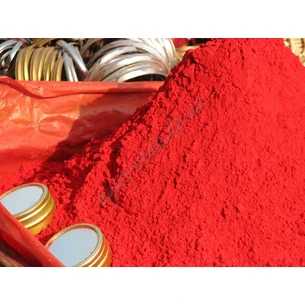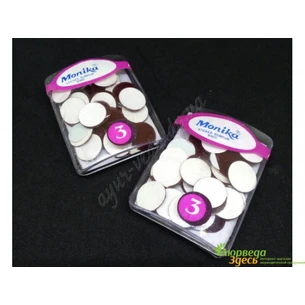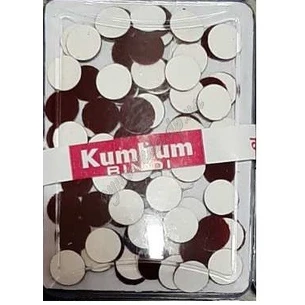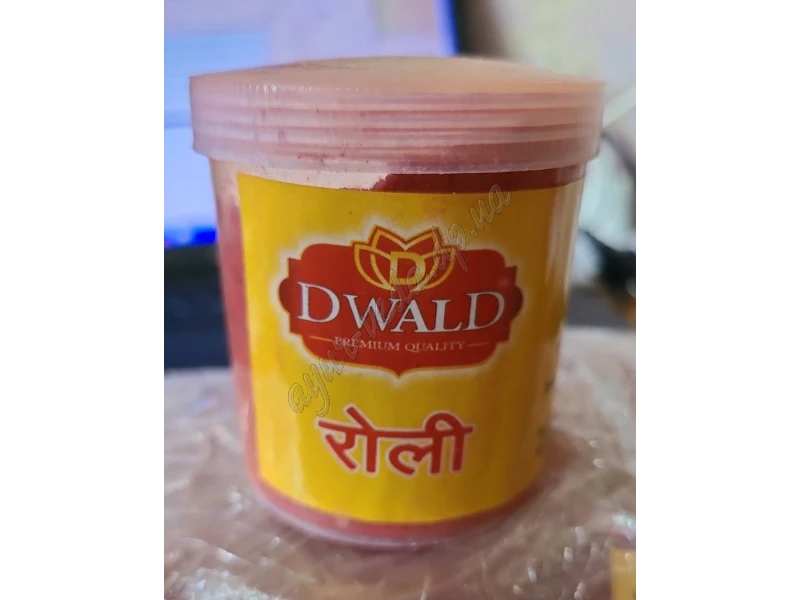
Package of 100 g.
Sindur or Kum Kum is intended for applying the Bindi point or along the parting on the head.
Bindi is the beauty of the forehead in the Indian way. It is worth assigning a zero to a unit, and its value will increase tenfold. The same can be said about bindi. Bindi is the most reddish-brown dot that can be seen on the forehead of Indian women. This point is not only a sign of marriage, as we know, but also a symbol of beauty and purity. Bindi is just one of many symbols used by Indian women to emphasize their honorable status. In addition, it is believed that bindi (or bindia) brings good luck to its owner. This national tradition is reflected in literature, sculpture and other forms of art. In ancient times, not women's foreheads were decorated, but men's. The paint contained sandalwood oil and ash. A woman whose forehead was decorated with a red dot symbolized luck and the rising sun. Of course, the materials that were used for binda many centuries ago have become a thing of the past. But the variety of these decorations has only increased: now you can choose a bindi for any outfit.
What is a bindi?
The bindi point is considered a special sign of belonging to the Vedic
culture, in this case to the Shaktist tradition. Each tradition
has its own distinguishing marks. Vaishnavs have tilaka, Shivaites have tripundra (three horizontal stripes on the forehead). Bindi is also a
general Hindu symbol, especially for women.
Bindi is translated from Sanskrit as a drop. A perfectly even bindi is applied exclusively by women. The earliest mention of binda, as well as tilak, is contained in the Rig Veda, in a hymn that describes Bhagavan Surya, whose consort - the Goddess Usha (Dawn) adorns her forehead with a red dot, as a symbol of the rising sun.
The binda itself is an auspicious sign that symbolizes purity of thoughts and consciousness, well-being and prosperity.
a). As for binda, which is applied only by women.
There is an opinion that the red color of binda symbolizes blood. There are opinions that in the ancient Aryan society there was a custom according to which the groom applied his own blood to the forehead of the bride as a symbol of marriage and marriage. Later, this custom was replaced by applying binda with sindoor or kumkum. Red bindi means family, i.e. the married status of a woman, although in South India wearing binda or pottu (Tamil) is obligatory for both girls and unmarried girls. When a wife comes to her husband's house with a red bandage on her forehead, this predicts prosperity and well-being for the newlyweds and at home. Kumkum is the dye for binda, which also plays an important role in the religious sphere. As a rule, married women paint the parting on the head red, but sindur is used for this. Kumkum and sindoor are two different materials, although they have the same color. Kumkum is made from red turmeric, and sindoor is made using zinc oxide.
If, unfortunately, a woman becomes a widow, she is forbidden to wear diapers. But, some people apply bindis made of turmeric (yellow color), which of course is not an indicator of a widow, but in order to show that the family is in mourning. In the same way, many women during "monthly problems" refrain from wearing bandages.
Both sindur and kumkum are recognized as auspicious symbols that attract everything bright and favorable to the life of the family. For women, it is expressed as a symbol of sobhagya or a symbol of well-being and prosperity in marriage.
b) As for the wearing of binda or dot by men.
Men wear a bright red binda as a symbol of spiritual purity and wisdom. Today, most men wear bindu made of kumkum during worship in temples, religious ceremonies or after such. And even then, in most cases, a single bindu does not look like an ideal circle, but rather stretched out or smeared upwards.
In addition to the religious meaning of the bindu in men, it is a reflection of their luck and good nature, but it mainly takes place during shada or marriage ceremonies.
In addition to kumkum, a dot is sometimes placed abhir or soot (not to be confused with ashes!).
c) why is bindu placed in the area between the eyebrows?
The area between the eyebrows corresponds to the location of the ajna chakra, for the most part, the area between the eyebrows is associated with knowledge and wisdom. During concentration, attention is gathered in the area between the eyebrows.
If we turn to the texts devoted to the subtle system of the human structure, as well as to the Vedic texts, we will learn that the power known as Kundalini, when awakened, tends upwards. In the ajna chakra, Kundalini-Shakti unites with Sadashiva, and a person finds freedom from delusion and ignorance, and when the unity of the Absolute is achieved, which describes how the achievement of the sahasrar-chakra is described, a person achieves liberation.
Also, a tika or tilaka, like a bindu or a drop, in yogic practice serves as a "softening agent" during the awakening of Kundalini-Shakti, at the moment of its connection with Sadashiva.
Just as Bhagavan Shivaji is able to incinerate the entire Universe with the glance of his third eye, so does a sadhak during a spiritual transformation, when Shakti and Shiva unite, and there is only That which is not divided and eternally united. He turns to ashes everything that binds him with the fetters of ignorance, all the three worlds are destroyed for him.
Thus the jiva is freed from all fetters, recognizes his eternal nature and gains the knowledge of Atman - sat-chit-ananda.
When bindu or tilak is applied, everyone thinks that he is Brahman, free from all duality. Therefore, many temples are not allowed without tilak, because during the application of tilak, a person concentrates as much as possible on the Supreme, leaving his selfish "self" outside the temple.
Thus, the bindu can symbolize the fact that a person comes to the temple completely immersed in thoughts about God, for him there is no external, but only the Supreme.
d) why is the bindu red?
The most logical and confirmed the opinion about the color is that the red color symbolizes blood.
This has been preserved since ancient times, when when making a sacrifice, especially when worshiping the Deva, the tilak is placed with the blood of a sacrificial animal, this rule has been preserved even now, mainly in tantric worship during animal sacrifice.
Also, the red color symbolizes Shakti, so the shakta tilak has only red color. And in general, the blood was replaced by the red color of kumkum.
It can be added that today, in almost all temples, in all houses during the meeting of guests (of course, where ancient customs are observed), tilaks are always put with kumkum or chandan (sometimes yellow turmeric) as a sign of blessing and expression of wishes for the well-being of guests.
D) briefly about tilaks
In Sanatana Dharma, in Depending on the religious direction and sect, different tilaks are used.
Shaktis, as a rule, use kumkum and their tilak has the form of either a binda or a binda slightly smeared on the top.
Vaishnavas use sandalwood paste or clay from sacred places. Depending on the sect, clay is used from Dwaraka, Yamuna, Vrindavan, Ganga, etc., and in some Vaishnava sects, kumkum is also used, either in addition to tilak made of clay or sandalwood, or as an independent material. Vaishnava tilaka always has the form of a vertical line or a U-shaped form - urdhvapundra, which symbolizes Vishnu as a guardian who supports the universe with all beings. Although there are other variants of tilaks, both in shape and color, but this depends on one or another sect.
Shaivas use sacred ashes for tilak - vibhuti. The tilak of the Shivaites has the form of three horizontal lines - tripundra from bindu to between the eyebrows, similar to the fact that Shiva is the Lord of creation, maintenance and destruction of the Universe. Also, the tripundra reminds of the impermanence of the temporary and transitory nature of the phenomenal world and of the desire for liberation from the three paths of the soul, and the desire for spiritual closeness to God.
The tilak of the devotees of Murugan (Kumar) is also the tripundra.
anapatis apply either tripundra or urhwapundra with a small line of kumkum in the middle.
Tilak saurovs (those who worship Surya as a manifestation of the Supreme Deity) has the form of two horizontal lines, the lower one of which is smaller than the upper one. chandana (sandal), aguru (aloe), kasturi (musk) and saffron.
So, not everything is as simple as it might seem at first glance. This is, of course, incomplete information, since the topic is quite extensive.
Modern Indian society completely accepts cloths, sequins and different colors, as a decoration and decoration without any meaningful application.
But as for religious and social symbols, most likely, they will be preserved for more than one millennium.
Kum-Kum powder 100g, anochka Dwal D Dwal Dkum kum Sindur, Ayurveda Here
Ayurveda Here! - an online store of Ayurveda, cosmetics, Indian tea, spices, Indian clothing and jewelry. The best selection of Ayurvedic products in Ukraine! Beauty and health for you and your family, esoteric shop, esoteric shop, souvenir shop, Indian souvenirs, sari, Saris, himalaya, Dabur, Nagarjuna, shatavari, incense, bijouterie, agarbatti, incense, Ayurvedic preparations from India, chavanprash, triphala, dabur, Himalaya,#ayurvedazdesde http://ayur-veda.dp.ua/