Producer: India
Rudraksha is the dried fruit of the Elaeocarpus ganitrus tree, which grows in some countries of South and Southeast Asia: India, Nepal and Indonesia. If we are completely accurate, then rudraksha is called a fruit collected precisely in Nepal. Grains grown in Indonesia are called indraks, and those harvested in India are called bhadraks. However, on the territory of Russia, the word "rudraksha" has rather a collective meaning, and under it they mean any fruit of the tree, regardless of the place of collection. The country of origin does not affect the quality and properties of grains.
Translated from Sanskrit, "rudraksha" means "tears" or "eyes" of Rudra - the Vedic deity, who is one of the aspects of Shiva, the destructive principle of the Universe. It is believed that rudraksha is given to people to save them from evil, gain the grace of the Gods, and strengthen their health. Truly miraculous properties are attributed to Rudraksha. However, its wearing and veneration, like all objects of worship, require special rules. Rudraksha has bioelectric properties that help balance electrical impulses in our body. Between the brain and the organs there is a constant bioelectric connection, the exchange of signals and impulses for the performance of body functions, maintenance of balance, blood circulation, etc. However, this chain can fail in those cases when we are nervous, anxious, or in a state of stress. This is the cause of psychosomatic disorders and general malaise. Due to its unique physical properties, Rudraksha acts as a storehouse of excess electrical impulses arising from an increase in the potential difference in the organs. In addition, rudraksha fruits have the property of dynamic polarity, i.e. able to change their polarity ("+" and "-") in the presence of an induced magnetic field (region of the heart, blood vessels and arteries), which ordinary magnets do not have. Thus, rudraksha helps to reduce the level of stress, normalizes psychosomatic chains and improves the functioning of the circulatory system.
Rudraksha fruits have so-called "faces", i.e. faces separated by clearly distinguishable stripes. In nature, there are rudrakshas with from one to twenty-one faces, while grains with one or two and more than 8 faces are quite rare and have a high value. The most available and popular are the three-, four-, five- and six-faced rudrakshas, in Russian stores you can most often find the five-faced rudraksha.
The five-faced rudraksha controls the five elements of the universe: Agni (fire), Jalu (water), Vayu (air), Prithiva (earth) and Akasha (space) in the body of the one who wears it. According to the scriptures, such a rudraksha is controlled by Jupiter and is able to compensate for negative manifestations of Jupiterian energies: fullness and cattle, excitement, fear of death, lack of faith in higher forces, difficulties with approval in society. Rudraksha with five faces is considered one of the best to use when reciting mantras: it is most often made into beads (rosaries). It helps to control blood pressure, work of the heart and the entire cardiovascular system, promotes concentration and perseverance.
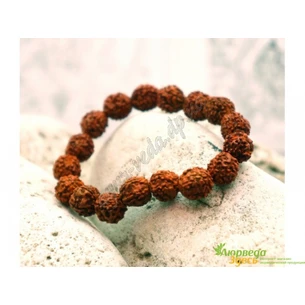
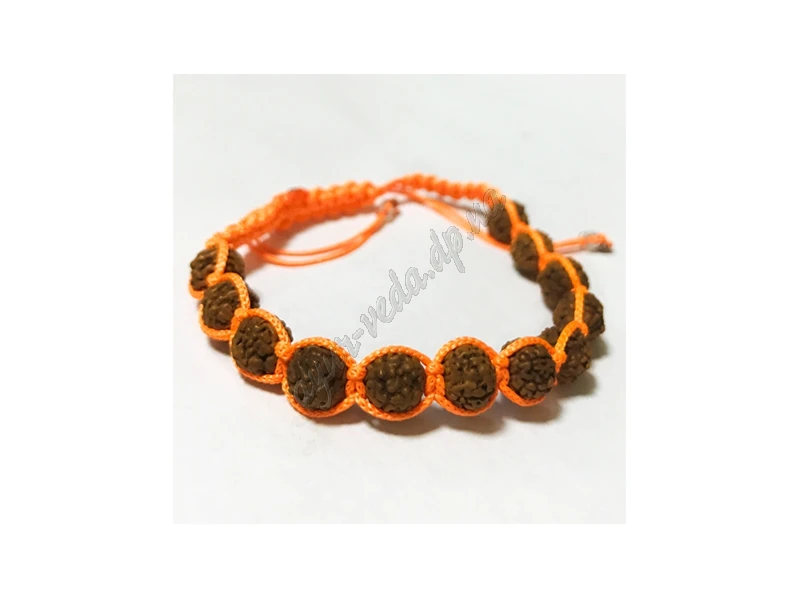
Rudraksha bracelet d = 10-12mm. 17 beads, Ayurveda Zdes
Ayurveda Zdes! - an online store of Ayurveda, cosmetics, Indian tea, spices, Indian clothing and jewelry. The best selection of Ayurvedic products in Ukraine! Beauty and health for you and your family! esoteric shop, esoteric shop, souvenir shop, Indian souvenirs, http://aur.in.ua/ #аюрведаздесь http://ayur-veda.dp.ua/