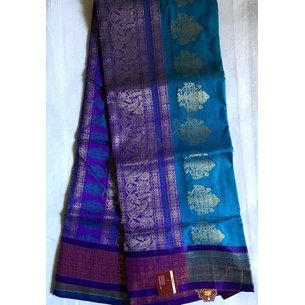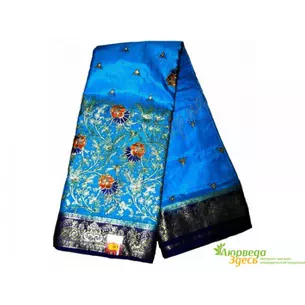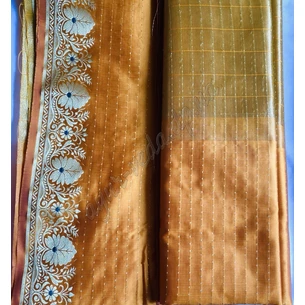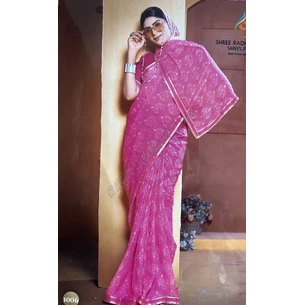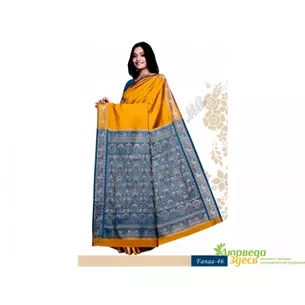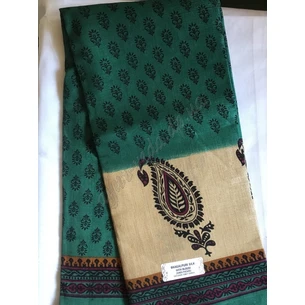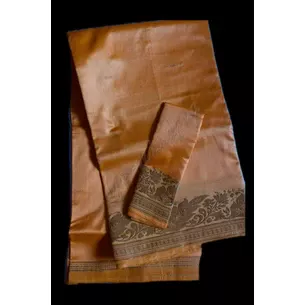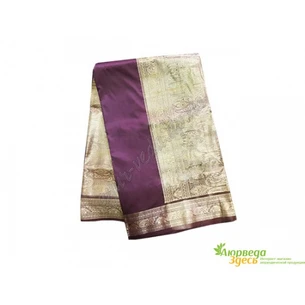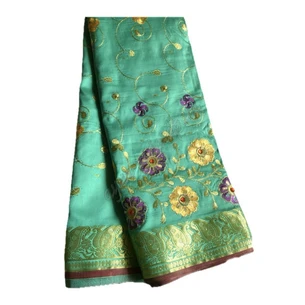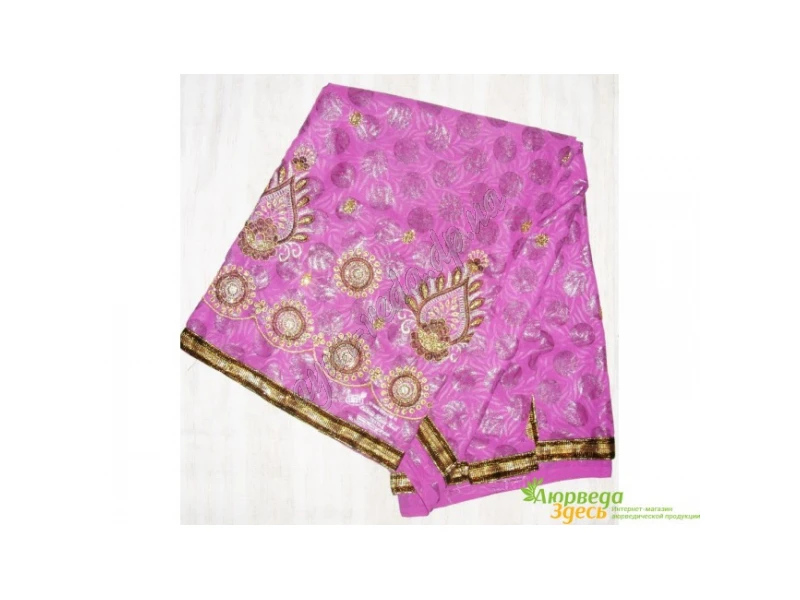
Length 5.5 m.
Composition: viscose 50%, polyester 50%
The Indian sari is a garment that allows a woman to feel like a real beauty, shrouded in mystery, exuding a sensual flair, admiring its elegance.
Despite the fact that in modern fashion, the tendency to wear a minimum of clothing, exposing the body as much as possible, is being followed by women in India a centuries-old tradition of wearing a sari — a simple piece of fabric, the length of which ranges from four to nine meters). What is the attractiveness of this ancient Indian outfit for women living in different countries of the world, whose material and spiritual culture are not related to India in any way? After all, not only models at fashion shows or world stars at various events, but also ordinary European women who use sarees for everyday wear wear sari as a decent alternative to an evening dress.
A little history...
In Indian legends, the fabric represents the creation of the Universe. "Sutra" (thread) is the basis and "sutradhara" (weaver) is the creator or creator of the Universe. The very word sary came from the Prakrit word sattika. In Sanskrit, "sati" means a strip of cloth. The history of Indian clothing is deeply rooted in the history of the Indian civilization, which flourished in 2800-1800 BC in the territory of modern India (Gujarat, Haryana, and Rajasthan) and Pakistan (provinces of Sindh and Punjab). The earliest known depiction of a sari on the Indian subcontinent is a statue of an Indus Valley priest wearing a draped cloth.
Some costume historians believe that the male dhoti (India's oldest draped garment) preceded the sari. Until the 14th century, dhoti was worn by both men and women. Sculptures of Gandhara (1st-6th centuries AD) depict goddesses and dancers dressed in what looks like a loincloth that falls freely to cover the legs and is folded in front. Above the waist, the body remains naked. From such written sources as "Ramayana" and "Mahabharata" it is known that the daily costume of both men and women consisted of a dhoti or a lunga (sarong) draped over the legs and a covering that covered the shoulders or was draped over the head. The Sari, consisting of a single piece of fabric, is a later innovation. Only from the 4th century AD. e. certain rules for wearing dhoti and saree are formed, elements of distinction between men's and women's clothing appear, and regional types begin to stand out in costume. The basis of the saree remains almost unchanged for many millennia.
The subject of a separate dispute is the history of the chola and the underskirt. Some researchers claim that they were unknown until the colonization of India by the British, and that these details of the costume were introduced to satisfy the Victorian requirements of modesty. Previously, women wore only one draped cloth and carelessly exposed their breasts. Other historians point to many textual and artistic evidences of the existence of various forms of breastbands, scarves and coverings.
Until the 20th century in South India, women of many tribes wore only sarees and left the upper part of the body open. Even today, women in some rural areas do not wear foreheads.
Sarees Sandhya-10 orchid chiffon, Ayurveda Zdes
Ayurveda Zdes! - an online store of Ayurveda, cosmetics, spices, Indian clothing and jewelry. The best selection of Ayurvedic products in Ukraine! Beauty and health for you and your family! Esoteric shop, esoteric shop, souvenir shop, Indian souvenirs, incense shop,http://aur.in.ua/