Package: 50 g
aka Chinese pepper, Japanese pepper, aniseed pepper
Botanical description.
Sichuan pepper is the fruit of the tooth tree (Zanthoxylum L.), also called prickly ash. It belongs to the family of Rutaceae (Rutaceae L.), genus Citrus (Citrus L.). It has several varieties that also differ in their places of origin: Sichuan pepper itself (Zanthoxylum piperitum L.) – from South China and Vietnam, Zanthoxylum sansho L. – from Japan, Zanthoxylum rhetsa L. – from Northern and Western India, Zanthoxylum fagara L. – from Central and South America.
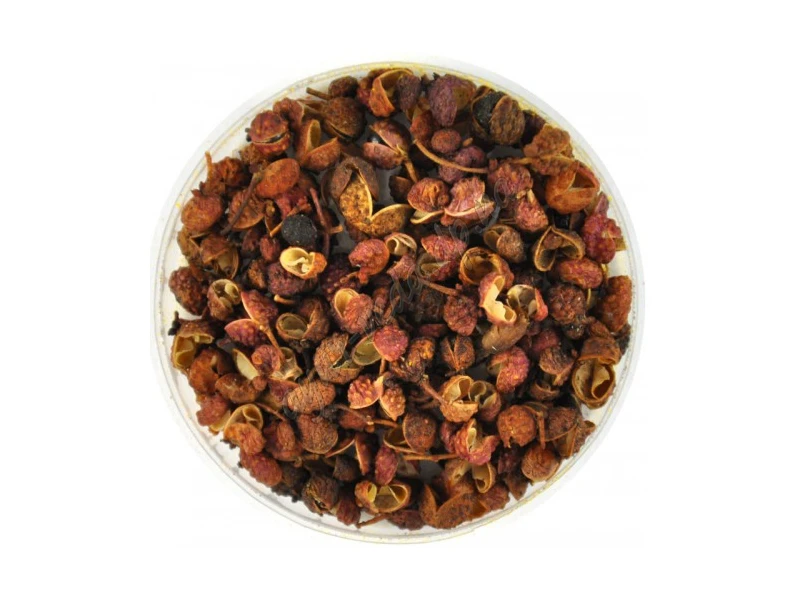
Dried fruits are brown-red kernels with half-opened flaps. The actual aromatic spice is the outer shell of the fruit, and the seeds themselves are bitter.
The spread of the spice.
The Chinese province of Sichuan is considered the birthplace of Sichuan pepper. Different varieties of it grow in the temperate climate zones of Northern China, Mongolia, Korea, Vietnam, Japan, Western and Northern India in the Himalayas, Tibet, North, Central and South America.
Preparation of spices.
As a seasoning, dried ripe fruits of plants similar to small nuts Usually, half-opened fruits come with cuttings and seeds, however, the used part of the spice, which carries the aroma, is the peel of the fruit. Sichuan pepper can be used in dishes both whole and ground. However, before grinding, it is necessary to remove the seeds from the fruits, because they carry bitterness.
In Japanese cuisine, in addition to the fruits of prickly ash, other parts of the plant are used - young buds and leaves with a refreshing mint-citrus aroma, flowers, green seeds.
The chemical composition of the spice.
The main component responsible for the aroma of Sichuan pepper is essential oil (up to 4%). Its composition includes terpenes - geraniol, linalool, cineole, citronellol. The dried fruits also contain up to 3% of amides, which give this spice its heat.
Other varieties of Sichuan pepper also differ in composition. American Zanthoxylum fagara contains alkaloids coumarin and lignin, Taiwanese Zanthoxylum simulans contains beta-myrcin, limonine, 1,8-cineole, beta-ocimine, Zanthoxylum armatum - contains linalool (50%), limonine, methylcinnamate and cineole, Indian Zanthoxylum rhetsa - sabinine, limonine, pinine, para-cymine and terpinene, monoterpene alcohols - 4-terpenol, alpha-terpenol.
Culinary properties and use of the spice.
Sichuan pepper is not a pepper at all. This spice has a subtle but strong citrus aroma with hints of lemon and warm woody tones. Some varieties of Sichuan pepper have an anise aroma. The taste of Sichuan pepper is insular, causing slight numbness in the mouth.
Sichuan pepper is a very popular spice in the kitchens of China, Tibet, Japan, and India. They season fish and seafood dishes, poultry, pork, beef, confectionery products.
The aroma of Sichuan pepper is very original, and some connoisseurs of this spice prefer not to mix its aroma with other spices. However, it harmonizes well with many spices and herbs. It is often combined with onions, star anise and ginger. In Tibetan cuisine, they love a composition of spices made of Sichuan pepper, onion, garlic and ginger. Sichuan pepper is included in the classic Chinese seasoning "wusianmian" - a mixture of five spices, consisting of star anise, fennel, cloves, cassia and Sichuan pepper.
In my opinion, Sichuan pepper is best suited for stewing meat. My favorite mixture of spices for cooking meat covered in spices and wrapped in foil in the oven: ground bay leaf, ground black pepper, ground nutmeg, Szechuan pepper (ground or whole), basil, thyme, marjoram - the result is an amazingly aromatic and rich taste.
Medicinal properties of spices.
Sichuan pepper has carminative and antispasmodic properties, cleanses the body and improves digestion.
It also acts as an anesthetic, causing numbness of the oral cavity. In large quantities it irritates the stomach.
Sichuan pepper 50g, sichuan pepper, Zanthoxylum piperitum L., Ayurveda Zdes
Ayurveda Zdes! - an online store of Ayurveda, cosmetics, Indian tea, spices, Indian clothing and jewelry. The best selection of Ayurvedic products in Ukraine! Beauty and health for you and your family, esoteric shop, esoteric shop, souvenir shop, Indian souvenirs, sari, Saris, himalaya, Dabur, Nagarjuna, shatavari, incense, bijouterie, agarbatti, incense, Ayurvedic preparations from India, chavanprash, triphala, dabur, Himalaya,#ayurvedazdesde http://ayur-veda.dp.ua/